Vale venue contract
Unchosen By My CEO Husband: A Marriage In Crisis Second Chance RomanceThe Vale venue contract is the concrete instrument around which the Renewal Centre’s crisis turns. Although it is initially unsigned, its association with the gala, the Vale family, and a venue worth two hundred thousand dollars gives it disproportionate power over Jacinta Colt’s work. The contract converts a practical arrangement into a test of loyalty: Aaron Colt treats access to the venue and the wider Vale development relationship as assets that must be protected, while Jacinta sees the same arrangement as the mechanism through which her authorship and reputation are being controlled.
Definition and Strategic Function
The Vale venue contract is the agreement governing the site for the Renewal Centre gala, held only ten days away when Jacinta confronts the danger surrounding it. The document sits in Aaron’s desk drawer, unsigned, while hundreds of guests and the influence of the Vale family remain poised to determine whether the event can proceed. Its importance is therefore not limited to a room or a date. A single call from the Vale family could affect everything Jacinta has built, making the contract a point of institutional dependence and a source of practical lock-in.
Aaron explicitly assigns the venue a value of two hundred thousand dollars. That figure becomes his justification for refusing an immediate confrontation with the Vales over the altered proof that has erased Jacinta’s credit. He presents the dispute as a temporary logistical problem and asks her to endure one more week, but the contract makes the requested silence materially consequential: preserving the event requires preserving the relationship that is threatening her standing within it.
The Contract and the Erasure of Credit
The contract’s pressure is inseparable from the campaign against Jacinta’s authorship. Cassandra Vale moved Jacinta’s walkthrough, circulated the claim that Jacinta was overwhelmed, and helped create an atmosphere in which the foundation could treat the designer as unstable. Jacinta identifies the issue not as a typographical mistake but as an erasure. Aaron, however, tells her that the Vale team should handle the ordinary logistics and that she should rest before Friday, effectively allowing the contract’s operational demands to override her claim to her own work.
The conflict sharpens when Jacinta identifies Celeste Colt’s embezzlement from the charity intended to open her centre. Aaron acknowledges the danger but insists that he will deal with his sister after the gala. He warns that a leak before Friday could cause the foundation to fold, kill the Renewal Centre, and place Jacinta’s project beside the word fraud in Chicago’s media coverage. The venue contract thus becomes part of a larger chain of exposure: the event depends on the Vales, the foundation depends on the event, and Jacinta’s public reputation is made vulnerable by both.
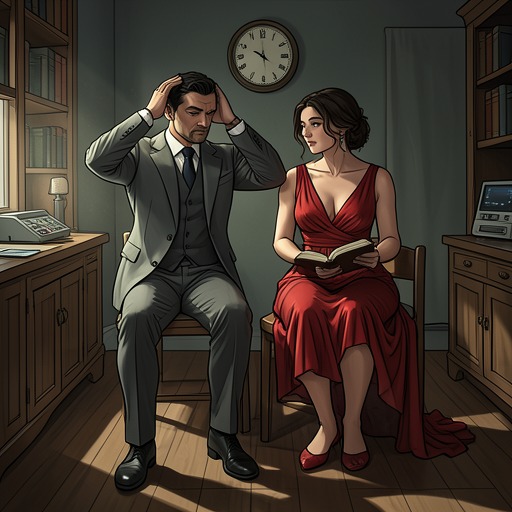
At the gala, Aaron watches Jacinta from ten feet away as he calculates the venue, the Vales, the contract, and the cameras. He once had the authority to force a board of directors into a decision within minutes, yet he rises only halfway from his chair before sitting down again. The contract’s power is shown through that non-action. It does not physically prevent him from defending Jacinta; it supplies the cost that he allows himself to treat as decisive.
Discovery and Reversal
After the gala, Jacinta demands to read the Vale contract and asks what she cost. Aaron tells her that it is in the second drawer of his office, among the important things. The document becomes evidence in the marriage as much as in the business dispute, because Jacinta wants to understand the price Aaron assigned to her protection and silence. When he later admits that he sat down at the gala while calculating the venue, the contract, and the exposure, he recognizes that the apparent numbers were also a moral choice: standing up felt more expensive than remaining seated.
The surrounding investigation exposes how the contract’s value was used to create the conditions for that choice. Elliot Grant obtains the hotel corridor log through a security contact, while Aaron’s IT team traces an email account made to resemble Jacinta Colt’s name and registered through a vendor on the Vale events payroll. Cassandra explains that the Vale development deal could be worth forty million dollars over five years and reminds Aaron that he deleted the message that might have allowed him to tell Jacinta the truth. Her formulation turns the contract into a symbol of the wider bargain: she staged a photograph, while he staged a marriage.
Aaron’s response is a direct rejection of the contract’s leverage. He tells Cassandra to keep the venue, slides a signed termination notice across the hotel bar, and states that he has released the security log and email registration along with a statement naming Jacinta as the actual designer of the Renewal Centre. He accepts that the disclosure will damage him, the board, the foundation, and the Vale family’s account. In this reversal, the contract loses its status as an asset worth protecting and becomes a price he is willing to pay for public attribution and truth.
Consequences and Lasting Significance
The contract’s consequences extend beyond the gala because it reveals how institutional dependence can make silence appear responsible. Aaron initially claims to be protecting Jacinta, but his protection preserves the arrangement that enables her exclusion. Elliot Grant’s testimony that Jacinta’s name appeared on Renewal files every week for three years, including site plans, budgets, correspondence, and initials recorded each Friday, establishes that the contract’s surrounding system did not merely mishandle credit; it concealed sustained work. Elliot calls his offer to speak about what he witnessed a deposition, converting observation into responsibility.
The later transfer of the Renewal Centre’s intellectual property completes the contract’s reversal. Aaron’s lawyers sign over every design file, plan, and piece of intellectual property touched by the foundation to Haven House Recovery Gardens, irrevocably, without conditions and without a reversion clause. Elliot witnesses the signatures and reads the transfer three times. When Jacinta receives the papers at the kitchen table while making bread with Theo Colt, she searches for a hook, a clause, or the smallest true thing that might conceal another demand, but finds none. The absence of conditions matters because it is the opposite of the contract logic that previously bound recognition to access, money, and institutional cooperation.
The Vale venue contract therefore functions as more than a business document. It is the material measure of Aaron’s earlier calculation, the instrument through which the Vale family’s power enters the Renewal Centre’s public life, and the object that exposes the difference between watching a crisis and accepting its cost. Its eventual surrender does not erase the damage caused by the concealment, but it establishes a new governing principle for the Centre: Jacinta’s work belongs to Jacinta, and repair must be made through an irreversible transfer rather than another promise controlled by someone else.